Wedding Venue Booking Checklist: 20 Questions to Ask Before You Pay the Advance (2026 Guide)
Wedding Venue Booking Checklist: 20 Questions to Ask Before You Pay the Advance (2026 Guide)
The wedding venue booking checklist is the single most important piece of paper you will carry into a banquet hall, farmhouse or resort — because in India, the venue is usually the biggest line item in the wedding budget, and the advance you pay to lock it is almost never refundable. Most couples walk into a venue visit dazzled by the chandeliers and the lawn, ask two or three polite questions, and hand over ₹50,000–₹2,00,000 as a booking advance before they know whether the kitchen can serve 800 guests, whether the DJ has to stop at 10 pm, or whether cancelling costs them everything. This guide fixes that. These are the 20 questions to ask before you pay the advance — grouped by what actually goes wrong — plus the red flags that mean you should walk away, and a printable checklist you can carry to every site visit.
Use it exactly as written: ask every question, write down the answer, and get the important ones in writing on the quotation or booking form before any money moves. A venue that answers clearly is a venue you can trust. A venue that dodges is telling you everything you need to know.
Why the Venue Advance Deserves a Checklist
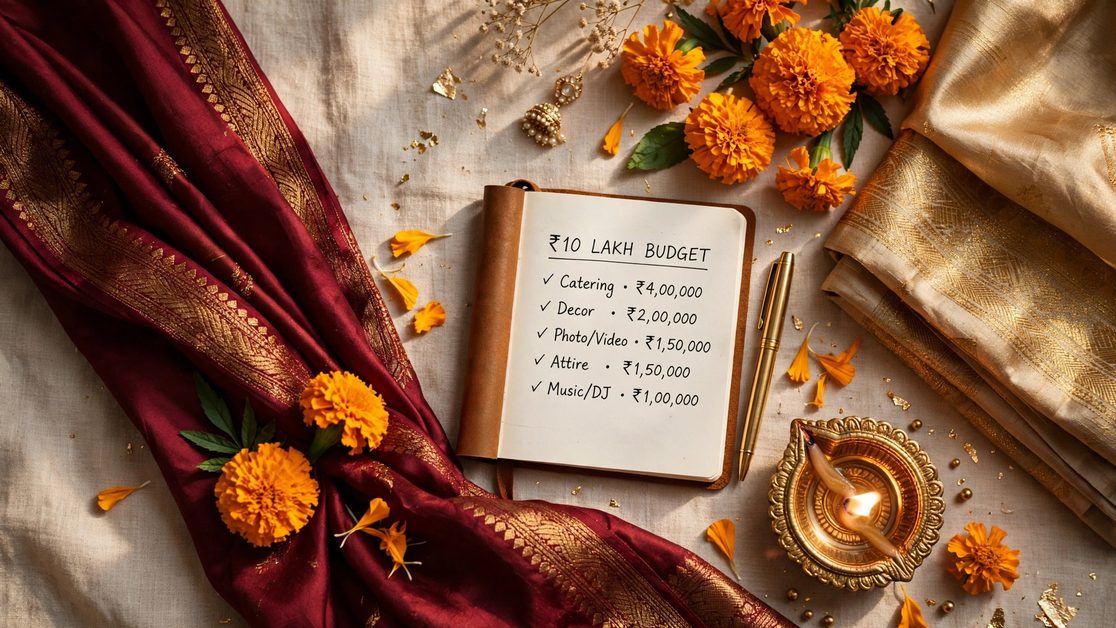
A wedding venue in India typically costs anywhere from ₹1 lakh for a modest community hall to ₹15 lakh or more for a premium hotel ballroom or destination resort — and that is before food, decor and the extras. The advance is usually 25–50% of the total, paid at booking, with the balance due in instalments before the wedding day. Once paid, that advance is very hard to recover: most venues have a strict no-refund or partial-refund policy, and even a date change can attract a penalty.
The second reason for a checklist is simpler: venue visits are emotional. You fall in love with a lawn at golden hour and forget to ask whether it has a rain plan. You love the ballroom and forget that the kitchen is outside catering only. The 20 questions below exist so the decision is made with your head as well as your heart — and so that two venues can be compared on facts, not feelings.
Part 1: Capacity, Dates and the Space Itself
1. What is the real capacity — seated and floating — for my functions?
Ask for the capacity for each setup, not one number. A hall that seats 500 for a wedding dinner may only seat 300 theatre-style for a sangeet, and a lawn that holds 1,000 floating guests may only seat 400 for a sit-down meal. Ask for the capacity of every space you plan to use: the ceremony area, the dining area, the sangeet stage area. Then compare that number honestly with your guest list — a hall packed to its absolute limit feels cramped, and a hall at half capacity feels empty. The sweet spot is a venue whose comfortable capacity is about 10–20% above your expected headcount.
2. Is my date actually available — and is it held for anyone else?
On popular dates, venues hold dates tentatively for more than one family. Ask plainly: is the date free, is it on hold for someone else, and until when? Ask how long they will hold it for you while you decide — 48 hours is common, a week is generous — and what happens if another family wants the same date while you are deciding. Never assume a verbal "it's yours" means anything. The date is yours only when the advance is paid and the booking is confirmed in writing.
3. What spaces are included, and what is the rain or heat plan?
Know exactly what you are paying for: the lawn, the hall, the bridal room, the parking area, the kitchen, the green room for artists. If your ceremony is outdoors, ask what happens if it rains — is there a covered hall of the same capacity available at no extra charge, or does the backup cost extra? For summer weddings, ask about cooling: how many air conditioners, whether the lawn has coolers or fans, and whether power backup covers them. A beautiful outdoor venue without a real backup plan is a gamble, not a booking.
Part 2: Money, the Advance and the Bill
4. What exactly is included in the quoted price — and what is not?
Ask for an itemised quotation, not a single figure. Does the price include the hall rent, basic lighting, tables and chairs, the stage, the bridal room, housekeeping and security? Or is it only the bare space, with everything else charged separately? In India, "venue rent" can mean anything from an empty hall to a nearly complete setup, and the difference can be lakhs. Get the inclusions in writing — if it is not on the quotation, assume it is not included.
5. How much is the advance, when is the balance due, and how do I pay?
Ask the advance amount, the payment schedule for the balance, the accepted payment modes, and whether GST is included in the quote or added on top. A typical schedule is 25–50% at booking, a further instalment a month before the wedding, and the final balance a week before or on the day. Also ask about the minimum guarantee: many venues charge for a minimum number of guests whether or not they turn up, and the final headcount must usually be confirmed 5–7 days before the event. Knowing the schedule in advance means no nasty surprise a week before the wedding.
6. What are the hidden charges nobody mentions on the first visit?
Ask directly: are there charges for electricity or generator backup, for cleaning after the event, for security, for valet parking, for extra hours, for the bridal room, for using your own decorator, or for corkage if you bring your own alcohol? Ask about service charges on top of the food bill — a 10% service charge on a ₹10 lakh food bill is ₹1 lakh. The question costs nothing. Not asking can cost a fortune.
7. Is there a minimum spend or minimum guest guarantee?
Some premium venues will not book for fewer than 300 guests, or they charge a minimum food-and-beverage spend. If your wedding is intimate — 150 guests at a venue built for 800 — you may be paying for 300 plates you will never serve. Ask for the minimum, and ask whether it changes on weekdays or in the off-season. Off-season and weekday weddings are often the best negotiation lever a couple has.
Part 3: Cancellation, Date Changes and the Fine Print
8. What is the cancellation policy — in exact rupees, not vague words?
This is the question most couples never ask and most regret skipping. Ask: if I cancel six months out, three months out, one month out, what do I get back? Ask whether the advance is refundable at any point, whether a cancellation fee is a flat amount or a percentage, and whether the venue will resell the date and refund you. Get the policy in writing on the booking form. "Non-refundable" should never be a surprise you discover after paying.
9. Can I change the date, and what does it cost?
Life happens — a family emergency, a muhurat change, a clash with another family event. Ask whether the date can be moved, how many days' notice is needed, whether the advance transfers to the new date, and whether there is a rebooking fee. Some venues allow one free date change within the same season; others treat a change exactly like a cancellation. Know which kind you are dealing with before you sign.
10. Will I get a written booking confirmation and a proper contract?
Never pay an advance against a verbal promise or a WhatsApp message alone. Ask for a written booking confirmation that lists the date, the spaces, the inclusions, the payment schedule, the cancellation terms and the contact person — plus a GST invoice for every payment you make. If a venue will not put it in writing, that is itself the answer. Pay by bank transfer or UPI, never in cash without a receipt, and keep every receipt until after the wedding.
Part 4: Food, Catering and the Kitchen
11. Is catering in-house only, or can I bring my own caterer?
This is often the single biggest cost decision. Many hotels and premium banquets insist on in-house catering; many standalone lawns and halls allow outside caterers, sometimes for a fee. Ask the per-plate cost for veg and non-veg, what the menu includes, whether there is a separate charge for the kitchen or crockery, and whether an outside caterer pays a fee — and how much. If you have your heart set on a particular caterer, confirm this before you pay a rupee.
12. Can I do a food tasting, and when?
Ask when the tasting happens, how many people can attend, and whether it is free or charged. A tasting is your only chance to judge the food before 500 guests eat it — and it is also a good moment to meet the catering manager you will be dealing with on the day. If the venue refuses a tasting or charges heavily for it, ask why.
13. How does the venue handle dietary needs, live counters and outside food?
Ask about Jain food, no-onion-garlic preparations, allergy handling, and whether live counters (chaat, dosa, dessert) cost extra or are included in the per-plate rate. Ask whether you can bring your own sweets, wedding cake or dry-fruit boxes, and whether there is a charge for serving them. Small rules like these cause real friction on the wedding day if they are discovered late.
Part 5: Decor, Music, Timings and the Rules
14. Can I bring my own decorator, and are there decor restrictions?
Many venues have an in-house decorator or a panel of approved decorators and charge a fee for outside decorators — sometimes a flat fee, sometimes a percentage. Ask about the fee, about restrictions on nailing, drilling, hanging, candles, open flames, floral installations, and about whether decor can be set up the previous evening. If you have already booked a decorator, check this before you book the venue, not after.
15. What are the timing rules — setup, function hours, and the music deadline?
Ask when you get access for setup, what time the function must end, and — critically — what time amplified music must stop. In many Indian cities, local rules require loud music to stop by 10 pm, and venues enforce it strictly. Ask what happens if the baraat arrives late, whether there is a charge for extending by an hour, and whether the venue has dealt with police permissions for the procession. The best wedding plan in the world is useless if the music is switched off at the wrong moment.
16. What is the power backup situation — really?
Ask about generator capacity, whether it covers the kitchen, the air conditioning, the stage lighting and the sound system, and how long it takes to kick in. A venue that says "we have a generator" may mean a small unit that covers only the lights. In peak summer, a power cut without real backup is a wedding disaster. Ask, and if the answer is vague, treat it as a no.
Part 6: Guests, Logistics and the Wedding Day Itself
17. How much parking is there — and is it safe and managed?
For a 500-guest wedding, expect 100–150 cars. Ask how many cars the venue can park, whether parking is inside the premises, whether valet is available and what it costs, and whether there is separate parking for the baraat vehicles. Guests who spend 30 minutes hunting for parking arrive annoyed; guests who cannot find their car afterwards remember it for years.
18. What rooms and facilities are available for the family and the artists?
Ask about the bridal room (with a mirror, good light, attached washroom, and space for the makeup artist), a room for the groom, green rooms for performers and the DJ, and a holding area for the baraat. Ask whether these rooms are included in the rent or charged extra, and whether they are available from the morning for haldi and other functions. A venue with one small changing room for a 500-guest wedding is a venue that will cause a queue outside the only mirror.
19. What are the washroom, accessibility and safety arrangements?
Ask how many washrooms there are, whether they are cleaned through the event, whether there is a separate washroom near the dining area, and whether the venue is accessible for elderly guests and wheelchairs. Ask about first aid, fire safety, and whether there is a dedicated venue manager on duty throughout the event. These are unglamorous questions — and they are the ones that decide whether elderly relatives enjoy the wedding or endure it.
20. Who is my single point of contact — and will they be there on the day?
Finally, ask who you will deal with from booking to the wedding day: one named person with a phone number, not a rotating front desk. Ask whether that person will be present on the day, and who takes over if they are not. A venue with a dedicated coordinator who knows your function schedule is worth more than a slightly cheaper venue where nobody owns your event.
Red Flags: When to Walk Away from a Venue
Even if a venue answers all 20 questions, watch for these warning signs:
- No written quotation or contract. If everything is verbal, everything is deniable.
- Pressure to pay today. "Another family is about to book it" is sometimes true and often a sales tactic. A genuine hold of 48 hours is reasonable; a demand for an immediate advance is not.
- Cash-only payments with no receipt. You have no proof, no GST invoice, and no comeback.
- Refusal to show the space you will actually use. Always inspect the exact hall and lawn, not a showroom or a photograph.
- Vague answers on cancellation. If they will not say what you lose, assume you lose everything.
- Bad reviews about the same issue. One bad review is an anecdote; five reviews mentioning dirty washrooms or rude staff is a pattern.
If you see two or more of these, keep looking. The right venue will welcome your questions — because a couple that asks good questions is a couple that will not be surprised on the wedding day, and venues know it.
The Printable Checklist: Take This to Every Venue Visit
Copy this list into your phone or print it before you go:
- Real capacity (seated and floating) for each function
- Date availability, hold period, and competing holds
- Spaces included + rain / heat backup plan
- Itemised inclusions — what the rent actually covers
- Advance amount, balance schedule, GST included or extra
- Hidden charges: electricity, cleaning, security, valet, extra hours
- Minimum spend / minimum guest guarantee
- Cancellation policy in exact rupees at each stage
- Date-change rules and rebooking fee
- Written confirmation + GST invoice for every payment
- In-house vs outside catering, and any outside-caterer fee
- Food tasting: when, how many people, free or charged
- Dietary handling, live counters, outside food rules
- Own decorator allowed? Decor restrictions and setup time
- Function timings, music deadline, extension charges
- Power backup — capacity and what it covers
- Parking capacity, valet cost, baraat vehicle space
- Rooms: bridal, groom, green rooms, holding area
- Washrooms, accessibility, first aid, fire safety
- Named point of contact — present on the wedding day
After the Venue: The Next Steps
Once the venue is booked, the countdown starts. Confirm your final headcount with the venue 5–7 days before the event, share the final function schedule with your coordinator, and send your guests an invitation that carries everything they need: the venue name, the Google Maps link, the timings of each function, and the RSVP option. That is where a digital invitation earns its keep — one link with the map, the schedule and the RSVP, instead of a dozen WhatsApp messages answering "where is the venue?" one guest at a time.
On Jobitra, couples build that invitation in minutes: pick a template, add the venue and the timings, and share one link that works on every phone. The Celebration plan (₹499 for 3 months) covers a full multi-day wedding with the RSVP dashboard, background music, photo gallery and a custom invitation URL; the Family plan (₹1,499 for 6 months) adds more projects and the advanced RSVP dashboard for big guest lists. Browse the wedding invitation templates, check the plans, or open the app to start your invitation while the venue details are still fresh.
Frequently Asked Questions
How much advance do wedding venues in India usually ask for?
Most venues ask for 25–50% of the total estimated cost as a booking advance, with the balance in instalments before the wedding. Premium hotels may ask for a higher first instalment. Always ask whether GST is included, get the schedule in writing, and pay by bank transfer or UPI with a GST invoice — never in cash without a receipt.
How far in advance should I book a wedding venue?
For peak-season dates (November–February), book 8–12 months ahead; popular venues in metros get booked a year out. For off-season or weekday weddings, 3–6 months is usually enough, and you may negotiate a better rate. Whatever the timeline, never pay the advance before asking the 20 questions in this guide.
Is the venue booking advance refundable?
In most cases, no — or only partly, and only if you cancel well in advance. Cancellation policies vary wildly: some venues refund a portion if you cancel six months out, others keep the entire advance from day one. Ask for the exact refund at each stage of cancellation, in writing, before paying.
What is a minimum guest guarantee at a wedding venue?
It is the minimum number of guests the venue will charge you for, whether or not that many people attend. If the guarantee is 300 and only 220 guests come, you still pay for 300 plates. Confirm the guarantee, the per-plate cost, and the last date for revising the final headcount before you sign.
Can I negotiate the venue price?
Yes — especially for weekday weddings, off-season dates, and multi-function bookings at the same venue. Ask about a package price for two or three functions, a waiver of the outside-caterer fee, or a complimentary bridal room. Negotiate on the total package, not just the headline rent, and get every concession written into the quotation.
Should I book the venue before finalising the guest list?
Book the venue once you have a realistic guest range, not an exact count. You need to know whether you are inviting 200 or 600 people before you choose a space — the capacity decision comes first. Finalise the exact headcount with the venue 5–7 days before the wedding, once RSVPs are in.
Conclusion
The venue is the biggest cheque you will write for your wedding, and the advance is the hardest money to get back — so the hour you spend asking these 20 questions is the best-spent hour of your wedding planning. Ask about capacity and dates, money and hidden charges, cancellation and date changes, food and catering, decor and timings, parking and rooms, and the person who will own your event on the day. Write the answers down. Get the important ones in the contract. And if a venue will not answer clearly, walk away — the right venue is out there, and it will be glad you asked.
Once the venue is locked in, build the invitation that carries all of it to your guests: the venue, the map, the timings, the RSVP. Start with the wedding invitation templates on Jobitra — pick one that matches your venue's mood, add your details, and share a single link on WhatsApp. Your guests will thank you, and so will your venue coordinator.