Wedding Invitation Design Trends for 2027: What's Actually Changing (2026 Guide)
Wedding Invitation Design Trends for 2027: What's Actually Changing
Wedding invitation design trends for 2027 are shifting in a clear direction: invitations are becoming shorter to read, richer to look at, and far more interactive than the static cards most guests received even two years ago. If you are planning a 2027 wedding in India, the invitation your guests open on their phones will probably move, play music, carry your photos, collect RSVPs, and guide them to the venue — all from a single link. This guide walks through the ten changes that are genuinely taking hold, the trends that are fading, and how to pick the ones that suit your wedding without turning your invitation into a gimmick.
One honest note before we begin: nobody can give you exact percentages for how many couples will use a particular style next year, and any article that does is guessing. What follows is based on what designers, printers, and couples are actually doing right now — the patterns visible across new template releases, wedding showcases, and the invitations couples are sharing on WhatsApp and Instagram.
1. Motion-First Invitations: The Invite That Moves
The single biggest change in wedding invitation design for 2027 is motion. A static image used to be the whole invitation; now the opening moment is often animated — doors that swing open, a couple's names that fade in over a photo, petals that drift across the screen, or a short video clip that plays as the invitation loads.
This works because almost every guest opens the invitation on a phone. A phone screen rewards movement in a way a printed card never could, and a five-second animation creates the same feeling as opening a beautifully wrapped envelope. The practical rule is restraint: one opening animation and one or two subtle effects are enough. An invitation that animates everything — text flying in from every side while music blares — feels chaotic, not luxurious.
What to do: pick a template or design with a single, elegant opening motion — a fade, a slow zoom on your photo, or a gentle reveal of the couple's names. Test it on an older phone before sending it to 500 guests; if it stutters there, simplify it.
2. Bold Colour Is Back: Jewel Tones Over Pastel-Only Palettes
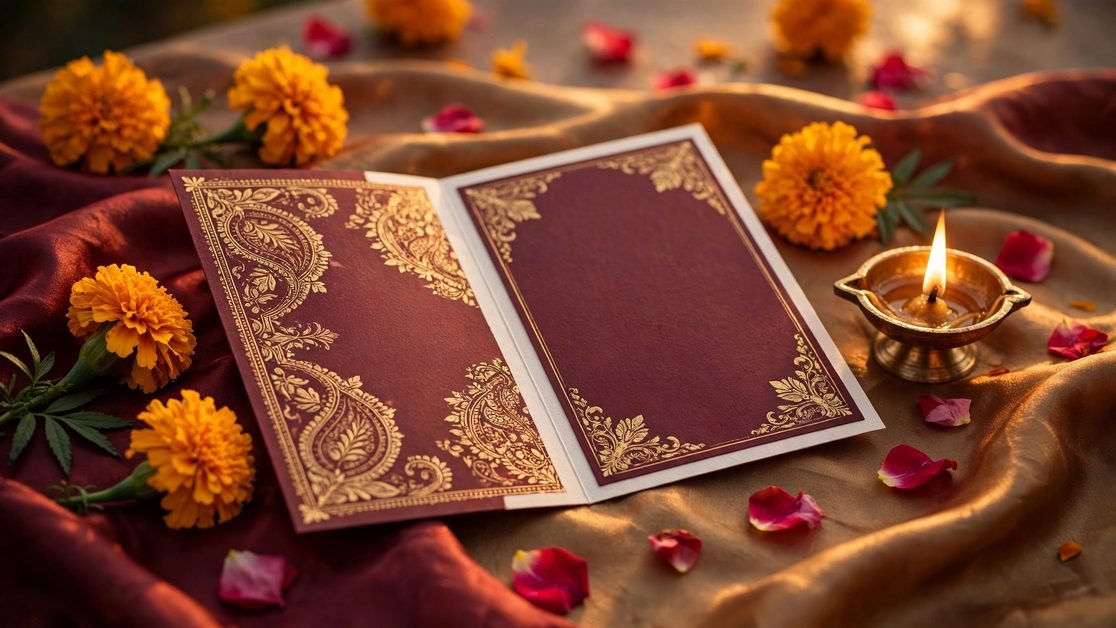
For several years, blush pink, sage green, and ivory dominated wedding invitations. Those soft palettes are not disappearing, but 2027 designs are pairing them with much bolder accents — deep maroon, emerald, royal blue, and rich gold. The effect is a card that looks traditional and modern at the same time: a deep maroon background with gold lettering, or an ivory base with a bold emerald border.
This shift suits Indian weddings particularly well, because the ceremonies themselves are colourful. A Haldi invitation in warm yellow, a Sangeet invitation in deep magenta, and a wedding invitation in maroon and gold give each function its own identity while keeping the set feeling like one wedding.
What to do: choose one bold colour and one neutral to anchor your design. Two bold colours competing for attention will fight each other; one bold colour with generous white or cream space looks deliberate and expensive.
3. Typography-Led Design: Big Names, Fewer Decorations
The third trend is almost the opposite of the second: invitations where the couple's names do all the work. Large serif or elegant script lettering, plenty of empty space, and almost no decorative borders. The names sit at the centre, the date sits underneath, and everything else — venue, functions, RSVP — is kept small and quiet.
This minimal style photographs beautifully, which matters because guests screenshot invitations and share them on Instagram stories. It also ages well: a heavily decorated card can look dated within a year, while clean typography still looks current years later.
What to do: if you love ornate design, keep the ornament on one element — a decorative frame around the names, or a patterned border — and let the rest of the page breathe. If you love minimal design, invest in the lettering itself: the right font pairing is the whole design.
4. One Link for the Whole Wedding: Multi-Function Invitations
Indian weddings are rarely a single event, and 2027 invitations increasingly reflect that. Instead of sending a separate card for the Haldi, the Sangeet, the wedding, and the reception, couples are sending one link that carries every function — each with its own date, time, venue, and map link, all in one scrollable page.
Guests prefer this because they keep one link instead of searching through a week of WhatsApp messages for the right card. Couples prefer it because they update one place when a timing changes. The design challenge is keeping it readable: each function gets its own clearly labelled section, with consistent formatting so guests can scan for the event they care about in seconds.
What to do: order the functions chronologically, give each one the same layout (name, date, time, venue, map button), and put the main wedding ceremony first in visual weight even if a smaller function happens earlier in the week.
5. Photo-Forward Design: Real Photos, Not Just Illustrations
Stock illustrations of peacocks and paisleys still have their place, but 2027 invitations are increasingly built around the couple's own photographs. A full-screen engagement photo as the hero image, a small gallery of the couple's favourite moments, and a photo strip at the bottom of the invitation are becoming standard — not premium extras.
The reason is simple: guests open an invitation to see the couple. A photo makes the invitation personal in a way no illustration can, and phone cameras have made good couple photos easy to get. The design rule is quality over quantity: three well-chosen, well-lit photos beat twelve mediocre ones, and every photo should be shown complete, never cropped awkwardly at the edges.
What to do: pick one strong horizontal photo for the top of the invitation and two or three more for a gallery section. Make sure the photos are high resolution — a blurry photo on a beautiful template still looks blurry.
6. Regional Language First: Devanagari and Local Scripts Take Centre Stage
More couples are designing invitations in the language their families actually speak — Marathi, Hindi, Tamil, Bengali, Telugu, Gujarati — instead of defaulting to English and adding a translated line as an afterthought. In 2027, this is a design decision, not just a wording decision: Devanagari and other Indian scripts are being set in beautiful, properly shaped type, sized as large as the English text, and given the same design attention.
This matters because badly set Devanagari — cramped letter-spacing, broken conjuncts, or a font that was clearly designed for Latin letters — is immediately visible to anyone who reads the script. Good regional-language design means choosing a font made for that script and letting the language lead the layout.
What to do: if your invitation is bilingual, give both languages equal visual weight rather than shrinking one into a footnote. And always proofread the regional-language text with a family member who reads it fluently — autocorrect and copy-paste errors in Devanagari are easy to miss if you only skim.
7. Interactive Elements: RSVP, Maps, Music, and More — Inside the Invite
The invitation is becoming the wedding's control panel. In 2027, guests increasingly expect to tap an RSVP button, open the venue in Google Maps, hear a background song, and watch a countdown to the muhurat — without leaving the invitation or downloading an app.
Each of these features solves a real problem. The RSVP button replaces the awkward "please reply" message and gives the couple a headcount. The map button stops guests from calling the family for directions. The countdown builds excitement. The trick is to include only the interactions your guests will actually use: an RSVP button and a map link are near-universal; a scratch card or a photo-upload section is a delightful extra for some weddings and clutter for others.
What to do: put the RSVP button and the map link where guests can find them without scrolling — near the top, right after the main details. Keep the music optional and easy to mute; not every guest wants sound the moment they open a link.
8. The Eco-Conscious Touch: Digital-First, Honest Green Choices
Sustainability is showing up in invitation design in a quieter, more honest way than the "eco wedding" headlines suggest. The clearest change is digital-first: couples who would once have printed 500 cards now print a small number for elders and close family, and send a digital invitation to everyone else. The invitation itself often says so plainly — "We've gone digital to save paper" — rather than dressing it up.
Other touches are appearing too: seed-paper cards for the few printed invitations, QR codes printed on the physical card that link to the full digital version, and a line in the digital invitation about the couple's choice. What is fading is the vague green claim with nothing behind it; guests notice when the wording and the reality do not match.
What to do: if you go digital-first, say so in one honest line and print a small number of beautiful cards for the people who will treasure a physical keepsake. That balance — digital for reach, print for sentiment — is what most 2027 couples are actually doing.
9. Personalised Illustration: Your Venue, Your Monogram, Your Story
Generic decoration is giving way to personal illustration. Couples are commissioning or choosing templates with a sketch of their actual venue, a monogram made from their initials, a small illustrated map of the wedding location, or motifs drawn from their own story — the city they met in, a flower from the bride's hometown, the couple's pet.
Done well, one personal illustration makes an invitation unmistakably yours. Done badly — five different motifs competing on one page — it looks like a scrapbook. The 2027 approach is one strong personal element, used consistently: the same monogram on the invitation, the welcome sign, and the thank-you message.
What to do: pick the single personal element that means the most to you and build the design around it. If you cannot decide between three ideas, choose the venue sketch — it is the one guests will actually recognise and remember.
10. Rich, Dark Backgrounds: The Evening-Look Invitation
The last trend is the most visual: deep, dark backgrounds — midnight blue, charcoal, deep plum, dark green — with light gold or cream text. Where the classic wedding invitation was a light card with dark text, the 2027 evening look reverses it, and the result feels like a formal evening event.
Dark backgrounds suit photo-forward designs especially well, because photographs glow against them, and they suit Sangeet and reception invitations, which are evening events. They need care, though: light text on a dark background must be large enough to read comfortably on a phone in sunlight, and decorative details must have enough contrast to be visible rather than disappearing into the background.
What to do: use dark backgrounds for evening functions and lighter backgrounds for daytime ceremonies like the Haldi. And always check readability on a real phone outdoors — a design that looks stunning on a laptop in a dark room can be unreadable in daylight.
What's Fading in 2027
Not every change is an arrival; some familiar habits are quietly leaving:
- PDF-only invitations. A PDF attachment that guests must download, zoom, and pinch is being replaced by a web link that opens instantly and fits the phone screen. PDFs still work as a printable keepsake, but they are no longer the main invitation.
- Generic floral borders on every card. The same rose border on every invitation, regardless of the couple or the ceremony, is giving way to design that reflects the actual wedding.
- Walls of text. Long paragraphs about the couple's journey, the family history, and the full schedule in one block are being cut into short sections with clear headings. Guests scan; they do not read essays on an invitation.
- Cluttered single pages. Invitations that try to fit the Haldi, Sangeet, wedding, reception, map, RSVP, photos, and a poem on one screen are being replaced by clean, scrollable pages with one idea per section.
- Fake luxury signals. Gold foil effects, "royal" wording, and overblown adjectives are losing ground to honest, well-made design. Guests can tell the difference between a genuinely beautiful invitation and one that is shouting about how luxurious it is.
How to Choose the Right Trends for Your Wedding
Ten trends are too many for one invitation. Here is a short checklist to narrow them down:
- Start with your functions. A multi-day wedding with Haldi, Sangeet, wedding, and reception needs the multi-function structure (trend 4) more than anything else.
- Pick one visual identity. Choose either bold colour (trend 2) or minimal typography (trend 3) or a dark background (trend 10) as your main look — not all three.
- Add one interactive feature first. The RSVP button (trend 7) saves you the most effort. Add maps next. Everything else is optional.
- Use your own photos (trend 5) if you have good ones; if not, a beautiful illustration or typography-led design will serve you better than a mediocre photo.
- Match the language to your guests (trend 6). If most guests read Marathi or Hindi, lead with it.
- Keep the print run small and meaningful (trend 8): print for elders and keepsakes, go digital for everyone else.
- Test on a real phone. Open the invitation on two different phones, in daylight, and ask someone who has not seen it before to find the venue and the RSVP button in under ten seconds. If they cannot, simplify.
Frequently Asked Questions
What is the biggest wedding invitation design trend for 2027?
Motion-first, interactive digital invitations. The invitation that guests open on their phone increasingly moves, plays music, collects RSVPs, and links to maps — all from a single link. Static images and PDF attachments are still used, but they are no longer the main format for most couples.
Are digital wedding invitations better than printed cards in 2027?
For most couples, a combination works best: a digital invitation as the main invite, because it reaches everyone instantly, carries RSVP and maps, and can be updated if timings change; plus a small print run of beautiful cards for elders, close family, and anyone who values a physical keepsake. Going fully digital saves money and paper, while going fully printed makes last-minute changes painful.
What colours are trending for wedding invitations in 2027?
Bold jewel tones — deep maroon, emerald, royal blue, and rich gold — paired with ivory or cream, are the most visible shift, alongside dark evening backgrounds in midnight blue and charcoal. Soft pastels like blush and sage are still popular, but they are increasingly used as accents rather than the whole palette.
How much should a wedding invitation design cost in 2027?
It depends on the format. A printed designer card can cost anywhere from a few dozen rupees to several hundred rupees per card depending on paper, printing, and embellishments, and a 500-guest print run adds up quickly. A digital invitation, by contrast, is typically a flat fee: on Jobitra, for example, the Celebration plan is ₹499 for a full year and covers web invitations with RSVP, maps, music, photo galleries, and premium templates — one price for the whole wedding, however many guests you invite. Always compare the total cost for your actual guest count, not the per-card price alone.
Can I use 2027 design trends and still keep a traditional look?
Yes — most of these trends work with traditional design. A maroon-and-gold invitation with a Devanagari heading, a venue sketch, and an RSVP button is both traditional and current. The trends that clash with tradition are the ones applied without restraint: too much animation, too many colours, or a dark background on a daytime religious ceremony. Choose one or two trends and let the traditional elements lead.
When should I send my wedding invitations for a 2027 wedding?
Send a save-the-date message 3–6 months before the wedding, and the full invitation 4–8 weeks before, with a reminder 1–2 weeks before the functions. Digital invitations make this easier because you can send the link in stages — save-the-date first, then the full invitation, then a reminder with the map and timings — without reprinting anything.
Conclusion: Pick Two Trends, Do Them Well
Wedding invitation design trends for 2027 point in one direction: invitations that are easier for guests to use and truer to the couple they celebrate. Motion, bold colour, clean typography, one link for every function, real photos, regional language, interactivity, honest eco choices, personal illustration, and rich dark backgrounds are all tools — and like any tools, they work best when you pick a few and use them well.
The couples whose invitations guests remember in 2027 will not be the ones who used every trend. They will be the ones who chose the two or three that fit their wedding, and executed them cleanly: a beautiful photo, one bold colour, a working RSVP button, and a link that opens perfectly on every guest's phone.
If you want to try these trends on your own invitation, browse the wedding invitation templates on Jobitra — including Marathi, Hindi, and English designs with animation, photo galleries, RSVP, maps, and music built in. Plans start at ₹499 a year with the Celebration plan, and you can see all options on the pricing page. You can also manage everything from your phone with the Jobitra app. Your invitation is the first thing your guests see of your wedding — make it feel like you.