10 Engagement Invitation Wording Ideas for Indian Couples

10 Engagement Invitation Wording Ideas for Indian Couples
The engagement — sagai, roka, nichayathartham, or ring ceremony, depending on your family — is where the wedding journey officially begins. It is usually the first time both families gather as one, which makes the invitation wording matter more than couples expect: it introduces the two families to each other, sets the tone for everything that follows, and tells guests exactly what kind of celebration to expect.
The challenge is that engagement wording sits between two worlds. It should carry the warmth and respect of a wedding invitation, but with the lighter, happier energy of a beginning rather than a culmination. These ten engagement invitation wording ideas cover every style — formal, modern, funny, Hindi, and WhatsApp-ready — each with a complete sample you can adapt.
10 Engagement Invitation Wording Ideas
- 1. The Classic Formal (Families Host)
The gold standard for traditional families: the parents of both sides jointly announce the engagement, name the couple with parentage, and request the guest's presence and blessings. This wording works across Hindu, Sikh, and Christian families with small adjustments to the opening blessing, and it is the safest choice when elders from both families will scrutinize every word. The formal "request the honour of your presence" phrasing signals that this is a significant family occasion, not a casual party. Use it for the printed card and as the main digital invite.
॥ श्री गणेशाय नमः ॥
With the divine blessings of our elders,
Mr. [Father's Name] & Mrs. [Mother's Name]
together with
Mr. [Father's Name] & Mrs. [Mother's Name]
request the honour of your presence at the Engagement ceremony of
[Bride's Name]
(D/o Mr. & Mrs. [Parents' Names])
with
[Groom's Name]
(S/o Mr. & Mrs. [Parents' Names])
on [Day, Date] at [Time]
at [Venue Name, City]
Your presence and blessings will make the occasion truly memorable. - 2. The Modern Couple's Announcement
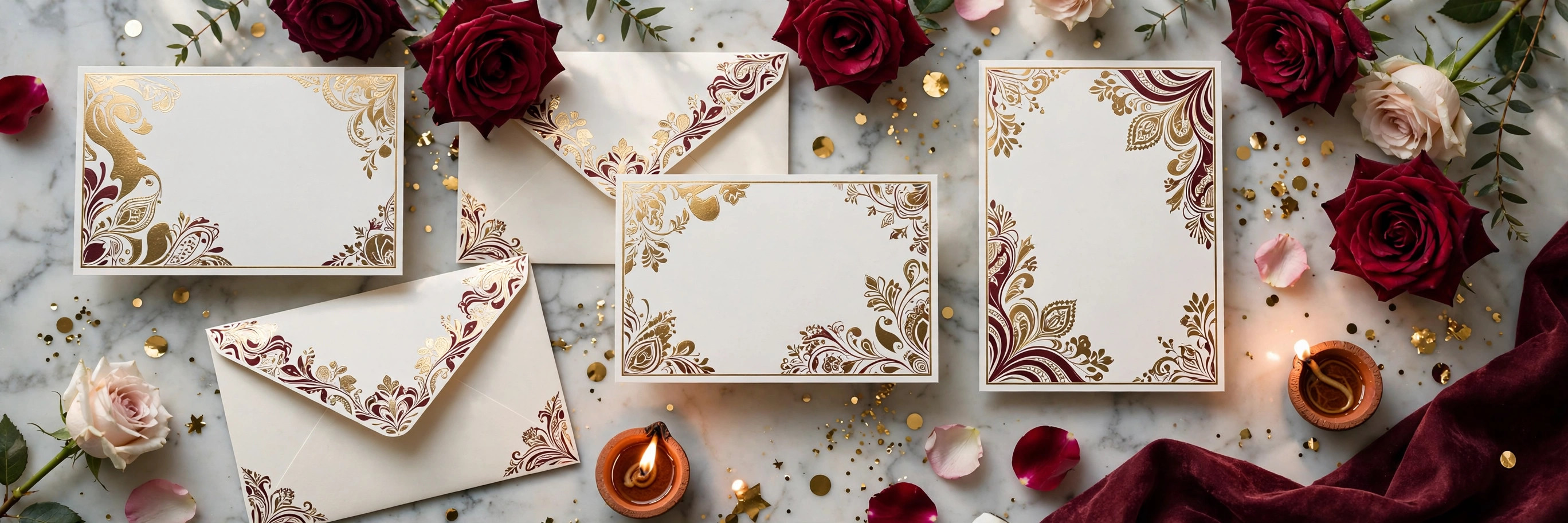
Many of today's couples host their own engagement — sometimes a roka, sometimes a simple ring exchange with close friends — and the wording should sound like them, not their parents. This first-person wording is warm, direct, and refreshingly honest: no "request the honour," just two people excited to share their news. It works beautifully for intimate engagements, interfaith couples navigating two sets of traditions, and anyone whose celebration is more dinner party than ceremony. Pair it with a contemporary card design from wedding invitation designs for modern couples — engagement cards live in the same collection.
We're getting engaged!
[Bride's Name] & [Groom's Name]
are delighted to invite you to celebrate their engagement
on [Day, Date] at [Time]
[Venue Name, City]
Join us for an evening of love, laughter, and new beginnings.
Dinner and drinks to follow — come hungry and happy! 🥂 - 3. The Roka Ceremony Wording
The roka is the Punjabi (and increasingly pan-Indian) ceremony where both families formally accept the match — often with gifts, sweets, and the first official photographs as a soon-to-be-married couple. Roka wording is typically joyful and slightly informal, reflecting that this is a happy family milestone rather than a solemn ritual. Mention the exchange of gifts or shagun if your family observes it, since guests love knowing what to expect. This wording suits the roka's spirit: celebratory, family-centred, and full of mithaas.
With the blessings of Waheguru and our elders,
the [Family Name] and [Family Name] families
joyfully announce the Roka of
[Bride's Name] & [Groom's Name]
Join us as the two families unite and bless the couple
on [Day, Date] at [Time]
[Venue Name, City]
Shagun and celebrations to follow. Your blessings mean everything to us! 🙏 - 4. The Ring Ceremony Invitation
When the engagement centres on the exchange of rings — common in South Indian nichayathartham ceremonies, Christian engagements, and modern urban celebrations — name it proudly. "Ring ceremony" wording is crisp and universally understood, cutting across regional terms that might confuse a mixed guest list. This example keeps the structure formal but the mood bright, and it works equally well printed or shared digitally. Add a line about the ring exchange timing so photographers (and aunties with phones) are ready for the key moment.
You are cordially invited to the Ring Ceremony of
[Bride's Name]
D/o Mr. & Mrs. [Parents' Names]
&
[Groom's Name]
S/o Mr. & Mrs. [Parents' Names]
on [Day, Date] at [Time]
[Venue Name, City]
Witness the exchange of rings and shower the couple with your blessings.
Reception dinner to follow. - 5. The Short WhatsApp Message
For friends, cousins, and colleagues, a punchy WhatsApp message beats a formal card every time. This template delivers the essentials — names, date, time, venue, RSVP — in under sixty words, with just enough warmth to feel personal. Send it one-to-one or via broadcast list about three weeks before the engagement, and attach your digital card below for the full details. Build that card in minutes with Jobitra's free web invite creator and share one link with everyone.
💍 We're getting engaged!
[Bride's Name] & [Groom's Name]
invite you to their engagement ceremony
📅 [Day, Date] | 🕖 [Time]
📍 [Venue, City]
Come celebrate with us — dinner to follow!
Kindly RSVP by [Date] 🙏 - 6. The Hindi Sagai Wording
For Hindi-speaking families, the sagai (सगाई) invitation in Hindi carries an emotional resonance that English cannot replicate. This wording uses the traditional respectful register — "सादर आमंत्रण," the request for "आशीर्वाद" — that elders expect, while keeping the details crystal clear. Many families print the Hindi wording as the main card and add a small English insert for younger or non-Hindi-speaking guests. If your family reads Roman script more comfortably, a Hinglish version of the same wording works just as well.
॥ श्री गणेशाय नमः ॥
सादर आमंत्रण
ईश्वर के आशीर्वाद एवं बड़ों के स्नेह से
[माता-पिता के नाम]
अपने सुपुत्र/सुपुत्री
[दूल्हे/दुल्हन का नाम]
के शुभ सगाई समारोह पर
आपकी उपस्थिति हेतु सादर आमंत्रित करते हैं।
📅 [तारीख] | 🕖 [समय]
📍 [स्थान]
पधारकर नवयुगल को आशीर्वाद प्रदान करें। - 7. The South Indian Nichayathartham Wording
In Tamil, Telugu, Kannada, and Malayali families, the engagement is the nichayathartham (or nischayam) — a formal ceremony where the wedding date is announced and both families exchange gifts and blessings. The wording traditionally opens with an invocation like "Sri Gurubhyo Namaha" or "With the blessings of Lord Venkateswara," names the couple with their fathers' names, and often notes the muhurtham. This example honours that structure while staying accessible. If your family follows specific customs like exchanging seer or thamboolam, a line about it delights the elders.
Sri Gurubhyo Namaha
With the divine blessings of our elders and the grace of the Almighty,
Mr. [Father's Name] & Mrs. [Mother's Name]
invite you to the Nichayathartham (engagement) of their daughter
[Bride's Name]
with
[Groom's Name]
son of Mr. [Father's Name] & Mrs. [Mother's Name]
on [Day, Date] at [Muhurtham Time]
at [Venue Name, City]
Please grace the occasion with your presence and bless the couple. - 8. The Poetic and Rhyming Wording
Some couples want their invitation to sing. A short rhyming verse at the top — about rings, promises, and new beginnings — gives the card a keepsake quality that plain wording never achieves. Keep the poem to four to six lines so it charms rather than drags, then follow with the practical details in plain prose. This style suits romantic couples and works wonderfully for engagements that double as a small celebration with friends. Write your own couplet if you can; a personal rhyme, even an imperfect one, beats a borrowed verse.
Two souls, two hearts, one beautiful start,
A ring, a promise, a work of art.
[Bride's Name] & [Groom's Name]
invite you to witness their engagement
on [Day, Date] at [Time]
[Venue Name, City]
Come, bless the couple, and share in their joy —
an evening of music, dinner, and celebration awaits! - 9. The Casual Friends' Invite
Your friends don't need "request the honour of your presence" — they need the date, the venue, and a reason to be excited. This wording is pure you: playful, warm, and honest about what the evening will actually be (good food, good music, your two families meeting for the first time). It's the message you drop in the college group chat or send to your work besties. The "plus-ones welcome" line, if true for your event, will make you very popular. Save the formal wording for the family card; this one is for your people.
Big news, besties! 💍
[Bride's Name] & [Groom's Name] are making it official!
You're invited to our engagement party:
📅 [Day, Date] | 🕖 [Time] onwards
📍 [Venue, City]
Expect great music, better food, and our parents finally meeting your chaos.
Don't miss it — we need our favourite people there! 🎉 - 10. The Multi-Event Engagement
Many Indian engagements are not single evenings but mini-festivals: a mehndi or sangeet the night before, the engagement ceremony itself, and a family dinner after. This wording lays out the full run of events so guests can plan — especially important for outstation family. List each function on its own line with date and time, exactly as you would for a wedding itinerary. Send this version to close family and anyone traveling, and use a simpler single-event wording for the wider guest list.
Dear [Name],
Our engagement celebrations are almost here, and we'd love you at every one!
🎶 Sangeet & Mehndi — [Day, Date], [Time], [Venue]
💍 Engagement Ceremony — [Day, Date], [Time], [Venue]
🍽️ Family Dinner — [Day, Date], [Time], [Venue]
Hosted with love by the [Family Name] & [Family Name] families.
Please let us know which events you'll attend. We can't wait to celebrate together! ❤️
Engagement Invitation Etiquette
A few conventions keep everyone comfortable. Send invitations 3–4 weeks ahead — engagements are often planned faster than weddings, but guests still need notice. Name both families, not just the couple; the engagement is the families' first joint appearance. Clarify the dress code if there is one — "traditional festive" saves guests from guesswork. Mention gifts policy gently if your family prefers blessings only; a simple "your presence is the present" line handles it gracefully. And add a live wedding countdown to your digital invite — it turns the wait into part of the celebration.
Frequently Asked Questions
What is the difference between roka, sagai, and engagement wording?
They describe the same milestone with regional flavours: roka (Punjabi/North Indian) emphasizes the families' formal acceptance, sagai (Hindi) centres the ring-exchange ceremony, and engagement is the neutral English term. Choose the word your family actually uses — guests should recognize the event instantly.
How far in advance should I send engagement invitations?
Three to four weeks is ideal for local guests; six weeks for outstation family. Engagements are often arranged on shorter timelines than weddings, so a digital invitation sent promptly beats a printed card that arrives late.
Should the engagement invitation come from the couple or the parents?
Traditional family-hosted engagements use the parents' voice; modern couple-hosted celebrations use first-person wording. Match the voice to who is actually hosting — and when in doubt, a joint "together with their families" opening pleases everyone.
Do I need separate invitations for engagement and wedding?
Yes. The engagement is its own event with its own guest list (often smaller and more intimate). Send a dedicated engagement invitation now, and the wedding invitation later — reusing the engagement card for the wedding looks careless.
Can I invite people to the engagement on WhatsApp?
Absolutely — WhatsApp is the primary channel for engagement invitations in India today. Use a warm, complete message with all details, attach a designed digital card, and reserve printed cards plus personal calls for elders.
Announce Your Beginning Beautifully
Every love story deserves a beautiful first chapter. Create your engagement invitation free on Jobitra — pick a design you love, add your wording and details, and share it with everyone who matters in minutes. For more ideas, visit the Jobitra blog.