Wedding Guest List: How to Finalise Who Gets Invited (Indian Families) (2026 Guide)
Wedding Guest List: How to Finalise Who Gets Invited (Indian Families) (2026 Guide)
Finalising your wedding guest list is the single hardest decision in Indian wedding planning — harder than picking the venue, the menu, or even the outfits. Every name you add costs money, and every name you leave off risks hurting someone you love. A wedding guest list in India is never just a list of your friends: it is two families, three generations of relatives, your parents' friends, your colleagues, your neighbours, and everyone your grandmother insists "must be invited". This guide gives you a calm, step-by-step system to finalise your wedding guest list — the three-circle method, fair plus-one and children rules, per-function lists, polite ways to say no, and a headcount-to-budget table — so you can close the list without a family fight and without blowing your budget.
Why the Wedding Guest List Is the Hardest Part of Indian Weddings
In most countries, a guest list is the couple's friends and family. In India, a wedding guest list is a family negotiation. Your parents have people they have attended weddings for over thirty years, and every one of those invitations created an unspoken obligation to return the favour. Your in-laws have their own circle. Your relatives expect their whole family to be invited, not just one person. And because Indian weddings run across several functions — Haldi, Mehndi, Sangeet, wedding, reception — the same guest list multiplies into five different lists.
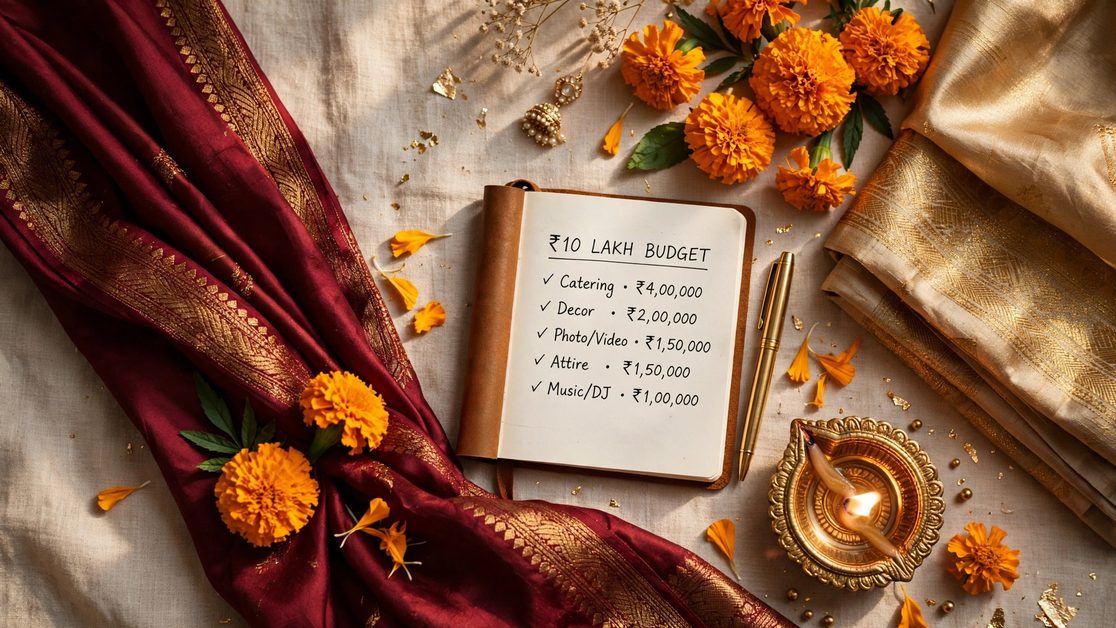
The second reason the guest list is hard is money. In India, each guest typically costs ₹1,000–₹2,500 in food, seating, and venue charges, depending on the city and the menu. Add 100 extra guests and you have added ₹1–2.5 lakh to your wedding. That is why the guest list is not a social decision — it is the biggest budget decision you will make. Every name on the list should be a deliberate choice, not a default.
The third reason is emotion. Saying no to a relative feels like a rejection of the relationship. Couples delay the list for weeks because every cut feels personal. The system below removes the personal sting: when you have clear, written rules, the list stops being about who you like more and starts being about a fair process both families agreed to in advance.
Step 1: Start with Capacity, Not with Names
Never start a guest list by writing names. Start with three numbers: your venue's seating capacity, your catering budget, and your total wedding budget. The smallest of these three numbers sets your maximum guest count.
First, check your venue. A banquet hall that seats 400 comfortably becomes miserable at 600. Ask the venue manager for the comfortable capacity, not the fire-safety maximum — the two numbers are often very different. Second, divide your food and venue budget by the per-plate cost. If you have ₹4 lakh for food and venue at ₹1,200 a plate, your ceiling is roughly 330 guests. Third, remember that every guest also needs a chair, a plate, parking space, and a place in the photographs.
Write the final number down and agree it with both families before a single name is discussed. A typical Indian wedding guest list falls into one of these bands: intimate (100–200 guests), medium (200–400), large (400–700), and grand (700+). Most families who start aiming for "around 300" and skip this step end up at 600, because nobody ever said the number out loud.
Step 2: The Three-Circle Method for Your Wedding Guest List
The three-circle method is the simplest fair system for an Indian wedding guest list. Draw three concentric circles and place every potential guest in exactly one of them.
Circle 1 — Must invite. Immediate family (parents, siblings, grandparents), the people who raised you, and your closest friends — the ones you speak to every week. If this person were not at your wedding, the day would feel incomplete. This circle is usually 60–120 people.
Circle 2 — Should invite. Extended family (uncles, aunts, first cousins), close family friends, your parents' closest friends, and colleagues you genuinely spend time with outside work. These are people you would be happy to see and slightly guilty to miss. This circle is usually 100–250 people.
Circle 3 — Nice to have. Distant relatives you meet once a year, your parents' acquaintances, neighbours, school friends you have lost touch with, and professional contacts. You like them, but your wedding day would not change without them. This circle is where the list explodes — it is often 200–500 people.
Now apply the rule: Circle 1 always makes the list. Circle 2 makes the list if the venue and budget allow. Circle 3 makes the list only if space remains after Circles 1 and 2 — and only by a rule both families agree on, such as "only relatives we have met in the last two years" or "only people either parent has spoken to in the last six months". A rule like that is fair, and it is much easier to explain than a personal choice.
Step 3: Give Each Side a Fair Share
The most common guest-list fight in Indian families is not about the total number — it is about whose side gets more names. Avoid it by agreeing on the split before the names are written. The fairest split is usually 50–50 between the bride's side and the groom's side, with a small shared pool (10–15% of the total) for the couple's own friends and colleagues, who belong to neither side.
For a 300-guest wedding, that means roughly 135 names for the bride's family, 135 for the groom's family, and 30 for the couple's shared list. Each side then applies the three-circle method inside its own quota. If one side has a much larger family, adjust the split — 55–45 or 60–40 — but agree the numbers first and write them down. A written split turns "your family is taking over" into "we agreed on 135 each".
One practical tip: let each side own its own list. The bride's parents collect the bride's side, the groom's parents collect the groom's side, and the couple collects their friends. Each side is responsible for correct spellings, phone numbers, and addresses — which also makes the invitation-sending stage far easier later.
Family Tiers: Who Counts as "Family" on an Indian Wedding Guest List?
Indian families disagree about where "family" ends. Agree on the tiers in advance, and the list almost writes itself.
Tier 1 — Immediate family. Parents, siblings and their spouses and children, grandparents. Always invited to every function.
Tier 2 — Close extended family. Uncles, aunts, first cousins and their families. Almost always invited to the wedding and reception; usually invited to Sangeet and Haldi too.
Tier 3 — Extended relatives. Second cousins, great-uncles and great-aunts, relatives by marriage. Invite to the wedding and reception if space allows; invite to smaller functions only if they are close to the couple.
Tier 4 — Family friends and parents' circle. Your parents' friends, their colleagues, and neighbours. This tier causes the most arguments, because your parents' social obligations live here. The fair rule is reciprocity: if your parents attended that family's wedding or major function, that family is on the list. If the connection is only "we know them", it is Circle 3 and can be cut.
Write the tier rule down and apply it the same way on both sides. When a relative asks why someone was not invited, "we invited everyone up to second cousins on both sides" is an answer nobody can argue with.
Plus-One Rules That Actually Work
Plus-ones are where guest lists quietly grow by 30–50%. Set the rule early and apply it to everyone, including yourselves.
Married couples and engaged couples: plus-one always. Never invite one half of a married couple. It is the fastest way to offend a guest.
Long-term partners: plus-one yes. If your guest has been in a serious relationship for a year or more, or lives with their partner, invite both — even if you have not met the partner yet.
Single guests: plus-one only for the wedding and reception, and only if space allows. A blanket plus-one for every single guest can add 50–100 names overnight. A kinder alternative is to invite single guests by name and let them know they are welcome to bring someone if they ask — most will not ask.
Children as plus-ones: see the children rule below; do not mix the two decisions.
Put the plus-one rule in writing and share it with both families. When everyone follows the same rule, nobody feels singled out.
Should You Invite Children to the Wedding?
Children are a budget and a logistics question as much as a social one. A child under 10 still needs a seat, a plate, and supervision — and a bored child at a four-hour ceremony is a stressed parent. There is no single right answer, but there is a right way to decide: pick one rule and apply it to every guest.
Option A — Children of immediate family only. Nieces, nephews, and the wedding party's children are invited; other guests' children are not. This is the most common choice for Indian weddings, and it keeps the list manageable.
Option B — All children welcome. Simplest socially, but add 15–20% to your headcount and budget for a kids' corner or entertainment.
Option C — Adults-only wedding and reception, children welcome at Haldi and Sangeet. A good compromise: the fun, daytime functions include the kids, and the formal evening functions stay adult-only.
Whatever you choose, state it clearly on the invitation itself — "We love your little ones, but this celebration is for adults only" is far kinder than a guest discovering it at the door. And never make exceptions for one guest's children and not another's: the exception becomes the argument.
One List or Five? Per-Function Guest Lists for Haldi, Sangeet, Wedding & Reception
Indian weddings are not one event, so your guest list should not be one list. The smartest approach is a master list with a column for each function. The same guest can be invited to all five functions, or only to the wedding and reception.
| Function | Who usually attends | Typical size (of a 300-guest wedding) |
|---|---|---|
| Haldi | Immediate family, close relatives, closest friends | 50–100 |
| Mehndi | Family, close friends, ladies of both families | 80–150 |
| Sangeet | Extended family, friends, colleagues | 150–250 |
| Wedding ceremony | Everyone on the master list | Full list (300) |
| Reception | Everyone, plus parents' wider circle and colleagues | Full list + 50–100 |
This structure solves two problems at once. First, it lets you honour close family with intimate functions without paying to host 400 people at every event. Second, it gives you a graceful way to include Circle 3 guests: invite them to the reception, the biggest and most open celebration, rather than to every function. A digital invitation makes this easy — one link can carry per-function details, so each guest sees exactly the functions they are invited to, with the right venue and time for each.
How to Cut the Guest List Without a Family Fight
Every Indian wedding guest list needs cuts. The difference between a fight and a calm conversation is how the cut is made and explained. Use these rules, in this order.
1. Cut by rule, not by person. "We are inviting relatives we have met in the last two years" is a rule. "We are not inviting Chacha's family" is a personal decision. Rules protect relationships; personal decisions damage them.
2. Cut the same way on both sides. If the bride's side cuts second cousins, the groom's side cuts second cousins too. Symmetry is the only defence against "but you invited your side".
3. Let parents make their own cuts. Each side's parents should decide their own Circle 3. They know the social obligations, and they will accept their own decision far more easily than yours.
4. Offer an alternative, not just a no. A relative who is not invited to the wedding can still be part of the celebration: invite them to the reception, send them the wedding video, or visit them with sweets after the wedding. The gesture matters more than the invitation.
5. Never announce cuts publicly. Do not discuss who was cut in family WhatsApp groups. The guest list is private until the invitations go out.
Copy-Paste Messages: How to Tell Someone They Are Not Invited
Sometimes a relative or friend asks directly, "Am I invited?" These messages keep the relationship warm while holding your boundary.
1. The small-wedding message (for distant relatives):
We are keeping the wedding very small — just immediate family and our closest friends — because of the venue size. We will miss having you there, and we would love to celebrate with you when we visit after the wedding. Your blessings mean everything to us.
2. The reception-instead message:
Our wedding ceremony is a small family function, but we would love you to join us at the reception on [date] at [venue]. It will be the big celebration, and we really want you there.
3. The parents' decision message (for your parents' circle):
Thank you so much for your love and blessings. Our parents have had to make some very difficult decisions about the guest list because of the venue capacity, and we are keeping the wedding to close family. Please bless us from home — we will come and meet you with sweets after the wedding.
4. The colleague message:
We are keeping the wedding to family and very close friends, so we won't be able to invite everyone from work — but we would love to celebrate with you at the office when we are back. Thank you for understanding.
5. The honest budget message (for close friends you genuinely cannot include):
I wish we could invite everyone we love, but the venue holds only [number] people and we have had to make painful choices. You mean a lot to us — please know this decision was about space, not about our friendship.
Send these personally, not as a group message, and send them before the invitations go out. Hearing it from you directly is always better than hearing it from someone else.
Guest Count to Budget: What Each Extra Guest Really Costs
Use this table to show both families what the list means in rupees. Per-guest costs vary by city and menu, but the shape of the maths is the same everywhere.
| Guest count | Food only (@ ₹1,200/plate) | Food + venue share (@ ₹1,800/guest) | Full cost (@ ₹2,500/guest) |
|---|---|---|---|
| 150 guests | ₹1,80,000 | ₹2,70,000 | ₹3,75,000 |
| 300 guests | ₹3,60,000 | ₹5,40,000 | ₹7,50,000 |
| 500 guests | ₹6,00,000 | ₹9,00,000 | ₹12,50,000 |
| 700 guests | ₹8,40,000 | ₹12,60,000 | ₹17,50,000 |
Cutting 100 guests from a 500-guest list saves roughly ₹1.8–2.5 lakh — enough to pay for the photography, the outfits, or the honeymoon. When a family member pushes to add 50 names, show them this table and ask which of those three things they would rather cut instead. Numbers end arguments that feelings cannot.
10 Mistakes Couples Make with the Wedding Guest List
1. Starting with names instead of a number. Without a capacity ceiling, the list grows until the budget breaks.
2. Letting one side write the whole list. Both families must own their half, or resentment follows.
3. Inviting out of guilt. "We have to invite them because they invited us in 2012" is not a reason — it is a debt you never agreed to.
4. Forgetting plus-ones in the count. A list of 300 named guests with plus-ones is really 380 people. Count the plus-ones from the start.
5. No RSVP deadline. Without a deadline, you will be chasing confirmations the week of the wedding. Set it 2–4 weeks before the wedding and follow up once.
6. Sending paper invitations before the list is final. Printed cards cannot be un-sent. Finalise the list first, then print or send.
7. One list for all functions. Inviting 400 people to the Haldi wastes money and crowds an intimate ceremony.
8. Ignoring the venue's real capacity. The "maximum" the venue quotes is a fire-safety number, not a comfort number.
9. Keeping the list in someone's head. A guest list lives in a shared spreadsheet with names, phone numbers, function columns, and RSVP status — never in memory or scattered WhatsApp chats.
10. Finalising too late. Close the list at least 8 weeks before the wedding. After that, additions need both families' agreement, not one person's impulse.
Final Wedding Guest List Checklist (Copy This)
- Venue capacity, catering budget, and total budget agreed — maximum guest count written down
- Split agreed: bride's side / groom's side / couple's shared pool
- Three circles drawn for each side; Circle 1 locked, Circle 2 conditional, Circle 3 by rule
- Family tiers agreed (immediate, close extended, extended, family friends)
- Plus-one rule written and shared with both families
- Children rule chosen (immediate family only / all welcome / adults-only reception)
- Per-function columns filled in the master spreadsheet (Haldi, Mehndi, Sangeet, wedding, reception)
- Names, phone numbers, and addresses collected for every guest
- RSVP deadline set (2–4 weeks before the wedding) and printed on the invitation
- Cut-list messages sent personally before invitations go out
- List frozen 8 weeks before the wedding — additions need both families' agreement
Frequently Asked Questions
How many guests should we invite to an Indian wedding?
There is no right number — it depends on your venue capacity, your budget, and your family size. Intimate Indian weddings run 100–200 guests, medium weddings 200–400, large weddings 400–700, and grand weddings 700 or more. Start from your venue's comfortable capacity and your per-plate budget, and let the number follow from those, not from a round figure someone suggested.
How do we split the guest list between the bride's and groom's families?
The fairest starting point is 50–50, with a small shared pool of 10–15% for the couple's own friends. For a 300-guest wedding that is about 135 names per side and 30 shared. Adjust the split if one family is much larger, but agree the numbers in writing before any names are discussed.
Should we invite distant relatives to our wedding?
Invite distant relatives if they fall inside a rule both families agreed on — for example, relatives you have met in the last two years, or people your parents attended a function for. If the only reason is "we know them", they belong in Circle 3 and can be invited to the reception only, or not at all. A rule protects the relationship better than a personal choice.
Do we have to give every guest a plus-one?
No. Married and engaged couples and long-term partners should always be invited together. For single guests, a blanket plus-one can add 50–100 people to your list — invite single guests by name, and let them ask if they want to bring someone. Apply the same rule on both sides so nobody feels singled out.
How do we handle guests who expect an invitation but are not on the list?
Tell them personally, before the invitations go out, with a short honest message (see the copy-paste scripts above). A small wedding, a venue limit, or a reception invitation instead are all kind, honest reasons. Never let them hear it from someone else, and never discuss cuts in a family group chat.
When should the wedding guest list be final?
Freeze the list at least 8 weeks before the wedding. That leaves time to send invitations, collect RSVPs by your deadline (2–4 weeks before the wedding), confirm the final headcount with the caterer, and arrange seating. After the freeze, any addition needs both families to agree — and the budget to allow it.
Final Word: A Smaller List Is a Better Wedding
A wedding guest list is not a measure of how loved you are — it is a measure of how clearly you can choose. Every guest you cut with a fair rule is money and attention you can give to the people who are actually there: better food, more time with your parents, a calmer morning, and a ceremony you remember instead of a crowd you managed. Finalise the number first, apply the three circles honestly, agree the split in writing, and freeze the list eight weeks out. Then send invitations that make every guest on that list feel chosen — because they were.
Once your list is final, a digital invitation makes the rest easy: one link carries every function, venue maps, and an RSVP button that collects your headcount for you, so you stop chasing confirmations on WhatsApp. Browse the wedding invitation templates to find a design that fits your celebration, check the plans — the Celebration plan at ₹499 for 3 months includes the RSVP dashboard, while the Family plan at ₹1,499 for 6 months adds the advanced RSVP dashboard for multi-function weddings — and manage everything from the Jobitra app. Your guest list is the hardest decision; sending the invitations should be the easiest.