
Top Wedding Planning Mistakes Indian Couples Must Avoid
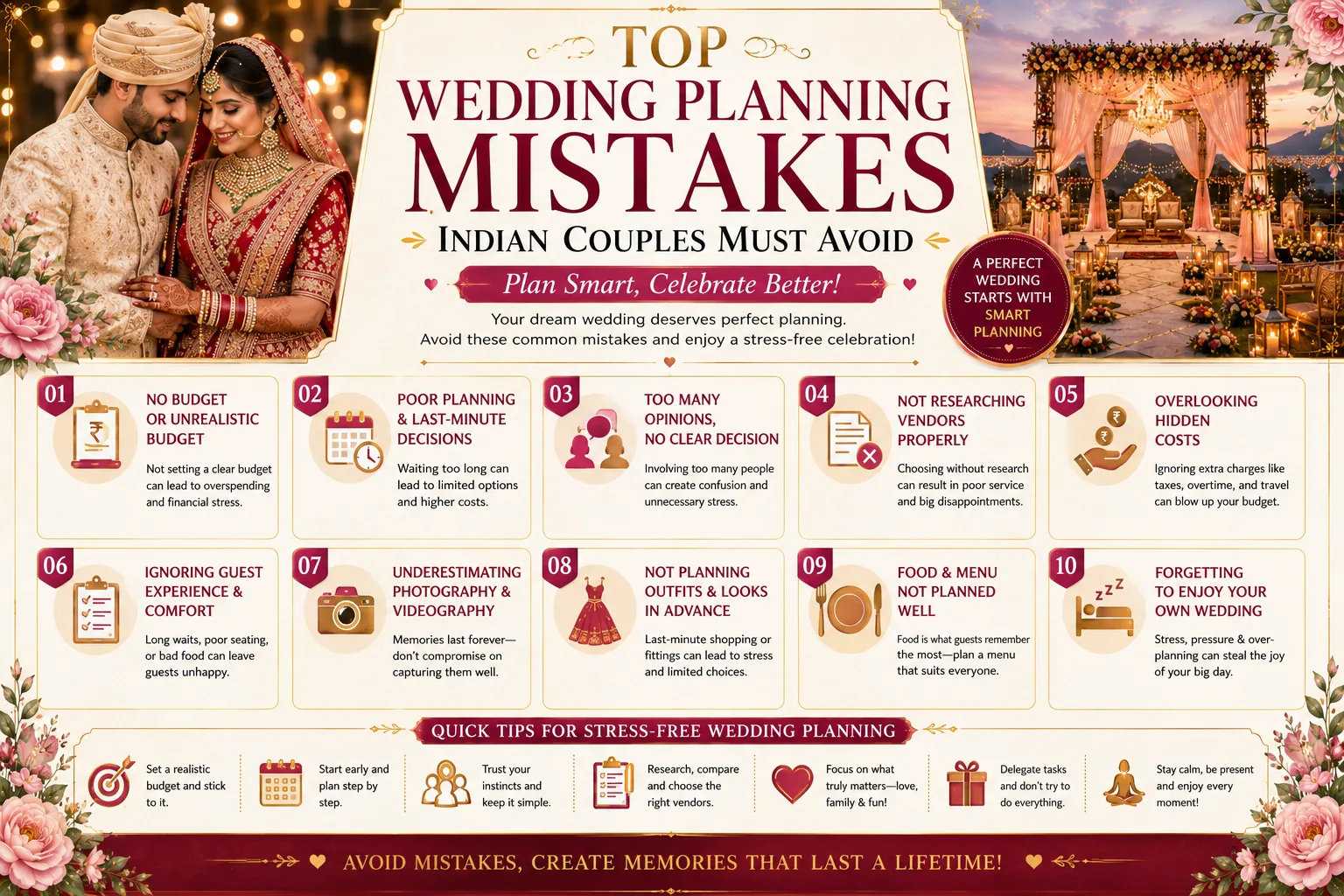
Top Wedding Planning Mistakes Indian Couples Must Avoid in 2026
Every wedding planner has a private list of mistakes they wish they could have warned the couple about. I am about to share mine. After helping families navigate hundreds of weddings, the same painful mistakes keep showing up — often the same way, often too late to fix. The good news? They are all avoidable. The better news? Most of them are obvious once someone points them out.
Here are the most common, most expensive, most heartbreaking wedding planning mistakes Indian couples make — and exactly how to avoid each one. Read this, save it, share it with anyone you love who is planning a wedding.
1. Not Setting a Real Budget Before Anything Else
The single biggest mistake. Couples start booking venues, photographers, and decorators before they actually know what they can spend. By the time they sit down to total it up, they are 40% over what they intended.
The fix: Sit down with everyone contributing financially (parents, in-laws, the couple themselves) and decide the maximum total budget first. Then allocate that budget across categories. Stick to it.
2. Trying to Please Everyone
You will fail. Your mother wants a grand wedding. Your father wants something modest. Your in-laws want their family priest. You want a destination wedding. You will not please all of them, so do not exhaust yourself trying. Pick the three priorities that matter most to you, fight for those, and compromise on the rest.
3. Skipping a Detailed Guest List Early
Until you have an actual guest count, every other decision — venue, catering, invitations, transportation — is just guesswork. Build your guest list within the first 30 days of planning. Yes, even before deciding the date.
4. Choosing a Venue That Is Too Small (or Too Big)
A 500-person guest list in a 250-person venue is claustrophobia. A 100-person guest list in a 500-person venue feels empty and embarrassing. Get the venue capacity right based on your actual confirmed guest count, not optimistic estimates.
5. Booking Vendors Without Reading Contracts
Indian wedding vendors are notorious for last-minute changes, vague pricing, and ambiguous deliverables. Always get everything in writing. Always read the contract. Always confirm the deposit and refund policy. This single step can save you lakhs in disputes.
6. Underestimating Catering Costs
Catering is almost always the largest expense at an Indian wedding. Couples regularly underestimate it by 30-40%. Add in service charges, taxes, beverage costs, late-night snacks, and morning breakfasts for the bridal party — and the bill snowballs fast.
The fix: Get detailed per-person quotes with all hidden costs spelled out. Compare at least three caterers.
7. Not Planning a Backup for Bad Weather
If your wedding is outdoors, you must have a Plan B. Monsoon weddings without indoor backup are the most common wedding disasters in India. Rain ruins decor, food, photography, and guest mood.
8. Ignoring Guest Comfort
Insufficient seating, no shaded waiting areas, long gaps between functions, no easy access to washrooms, no water stations — these are the details that make or break the guest experience. Walk your venue from a guest's perspective before the wedding.
9. Booking a Photographer Last Minute
The best wedding photographers in India book out 12-18 months in advance. If you wait until 3 months before your wedding to find one, you will either pay double or settle for someone you do not love. Photography is the only part of your wedding that lasts forever — invest in it early.
10. Skipping the Pre-Wedding Doctor Visit
Most brides do not realize how physically exhausting an Indian wedding is. Late nights, restricted diet, hours in heavy lehenga, dehydration, stress — your body takes a serious hit. Get a full health check three months before. Take vitamins. Sleep more than you think you need.
11. Not Hiring a Wedding Coordinator
Even if you cannot afford a full-time wedding planner, hire a coordinator for the wedding week itself. The cost (typically ₹50,000-₹1.5 lakhs) is recovered many times over in stress saved and details handled. You should not be answering vendor questions while in your bridal makeup.
12. Forgetting About the Honeymoon
Couples often plan the wedding for a year and forget to plan the honeymoon. By the time the wedding is over, they are exhausted, broke, and back at work two days later. Block your honeymoon dates before finalizing the wedding date.
13. Underestimating Wedding Outfit Lead Times
A custom designer lehenga takes 4-6 months to make. A complex sherwani takes 3-4 months. A simple boutique outfit needs at least 8 weeks for fittings and alterations. Start outfit planning at least 6 months in advance.
14. Not Designing the Digital Wedding Invitation Early
Your wedding invitation is the first impression of your wedding. Yet most couples leave it until two weeks before the event. Result: rushed designs, typos, missing event details, and poor RSVP tracking. Design and finalize your invitation at least two months before the wedding.
15. Overloading the Sangeet Schedule
An overloaded sangeet with 25 performances becomes a marathon nobody enjoys. Limit performances to 8-10 maximum. Add a DJ segment in between. Keep the total entertainment under 90 minutes.
16. Not Doing a Final Vendor Walkthrough
Seventy-two hours before the wedding, walk through every detail with every vendor. The florist, the decorator, the caterer, the venue manager, the entertainment coordinator. Confirm everything in writing again. This single step prevents 80% of wedding-day disasters.
17. Ignoring the Music Volume
Loud DJs ruin conversations during dinner. Soft DJs kill the dancing energy at the reception. Different functions need different sound levels. Brief your DJ in advance with specific volume guidance for each segment.
18. Skipping a Wedding Day Timeline
You need a minute-by-minute schedule for the entire wedding day — from bridal makeup at 4am to send-off at midnight. Share this schedule with the photographer, MC, family, and vendors. Without it, the day spirals into chaos.
19. Buying Cheap Jewelry
One thing I have seen over and over: brides who go cheap on bridal jewelry regret it within two years. The plating wears off, stones fall out, and what looked beautiful in photographs starts looking dated. Buy quality once.
20. Not Communicating With In-Laws
Surprises do not work at Indian weddings. Both families need to be in the loop on major decisions — the menu, the rituals, the guest list, the timeline. Keep a shared family WhatsApp group dedicated to wedding decisions. Document everything.
21. Forgetting About Wedding Day Logistics
Guest transportation, parking, room allocations for out-of-town guests, baggage handling, makeup-artist schedules — these logistics make or break the wedding. Hire a dedicated logistics manager or co-opt a no-nonsense uncle.
22. Choosing the Wrong Wedding Date
Cultural dates matter, but practical ones matter too. A wedding during exam season excludes young cousins. A wedding during peak monsoon means weather chaos. A wedding during major festivals competes with religious commitments. Pick a date that works for both tradition and reality.
23. Trying to DIY Too Much
Some DIY is charming. Too much DIY at your own wedding is exhausting and counterproductive. Reserve DIY for haldi or mehendi if you must. The main wedding and reception should be professionally handled.
24. Not Saving Original Footage
Photographers and videographers often delete raw footage three to six months after the wedding unless you request it. Ask for backup copies of all unedited footage. You may want them years later.
How to Avoid These Mistakes — A Practical Checklist
- Set a real budget in Month One
- Finalize guest list by Month Two
- Book venue and key vendors by Month Six
- Design digital wedding invitation by Month Three before
- Get all contracts in writing
- Hire a day-of coordinator
- Walk through everything 72 hours before
- Sleep more, stress less
FAQs About Wedding Planning Mistakes
What is the most common wedding planning mistake?
Underestimating the total budget by 30-40%. Couples consistently spend more than they plan. Build a 20% buffer into your budget from day one.
When should I start planning my Indian wedding?
Ideally 12-18 months in advance for traditional weddings, 6-9 months for intimate ones. Anything less than 4 months leads to compromises.
Is hiring a wedding planner worth it?
For weddings over 200 guests, almost always yes. For smaller weddings, a day-of coordinator is sufficient. Either way — do not try to plan and execute alone.
How can I avoid family conflict during wedding planning?
Open communication, shared decisions, clear budget discussions, and a shared family group chat. Set ground rules early. Be willing to compromise on small things to protect the big things.
Final Thoughts
Wedding planning is not about avoiding every mistake. It is about avoiding the ones that actually matter. Cake choice? Recoverable. Color of the napkins? Nobody remembers. Booking a photographer too late or skipping a backup weather plan? Those mistakes haunt you.
Start smart. Start early. Start with your digital wedding invitation on Jobitra.com — the foundation of every well-planned modern Indian wedding.