Indian Wedding Dress Codes Explained for Every Function
Indian Wedding Dress Codes Explained for Every Function
If you have ever stood in front of your wardrobe an hour before an Indian wedding, frantically WhatsApping your friend "yaar what are you wearing?" — this guide is for you. Indian weddings are stunning, dramatic, week-long affairs. And every single function has its own unwritten rules about what to wear, what colors are okay, what to avoid, and how much you can blend in versus stand out.
I have spent years helping couples plan their actual weddings and design their digital wedding invitations — which means I have also spent years getting frantic dress code questions from their guests. Here is the complete, function-by-function breakdown I wish someone had given me when I was 25.
Why Indian Wedding Dress Codes Are So Specific
Unlike Western weddings, Indian weddings are not a single event. They are an entire week — sometimes more — with rituals layered on rituals. Each function carries its own mood, its own color story, and its own outfit expectations. Showing up in a heavy lehenga to a morning haldi is like wearing a tuxedo to brunch. Possible, but you will regret it.
The good news? Once you understand the logic behind each function's dress code, you will never feel underdressed or overdressed again.
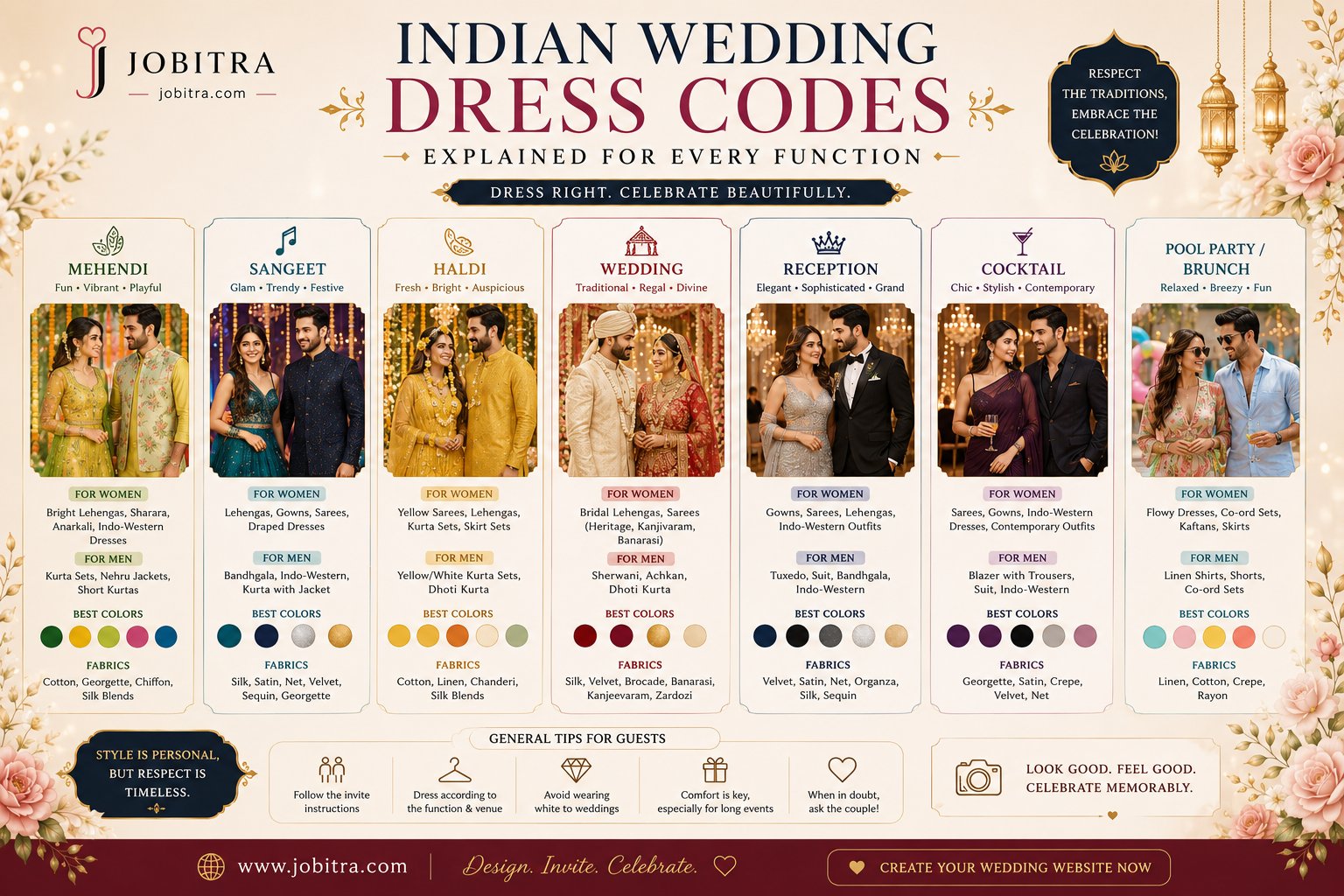
Haldi Ceremony Dress Code
What to Wear
Yellow. All the yellow. Mustard yellow, lemon yellow, marigold yellow, butter yellow — it is the one function where everyone is essentially color-coordinating with the bride and groom on purpose. Light cotton or chiffon outfits work best because turmeric paste will get on you whether you want it to or not.
Outfit Ideas
- Yellow cotton kurta with white palazzo or churidar (for men and women)
- Floral printed yellow saree in light fabric
- Pastel yellow anarkali with minimal jewelry
- Lehenga skirt with white blouse and yellow dupatta
What to Avoid
Anything white you actually care about. Heavy embroidered fabric. Silk that cannot be washed. Open-toe shoes you love. Trust me on this one.
Mehendi Ceremony Dress Code
What to Wear
Mehendi is where you can finally lean into color without going full-blown bridal. Think green, orange, pink, peach, lavender — anything bright and joyful. Floral prints are extremely on-trend right now. Fabric should be light enough to sit cross-legged in for two hours while mehendi dries on your hands.
Outfit Ideas
- Green or peach sharara set with mirror work
- Floral printed lehenga with crop top
- Light anarkali in pastel tones
- Pre-draped saree in cotton or organza
- Indo-western fusion suit sets
What to Avoid
Sleeveless if you are getting mehendi yourself (you cannot raise your arms easily for hours). Tight cuffs and bangles on your dominant hand. Black — most South Asian families still consider it inauspicious for ceremonies.
Sangeet Night Dress Code
What to Wear
This is the function where you dress to be photographed. Sangeet is glamorous, fun, and very Bollywood. Sequins, shimmer, deep jewel tones — bring it all. Floor-length lehengas, sleek sarees, designer gowns, even a sharp suit-and-bandhgala for the men.
Outfit Ideas for Women
- Heavy sequined lehenga in royal blue, emerald, or wine
- Pre-draped sequin saree
- Indo-western gown with cape
- Sharara set with statement earrings
Outfit Ideas for Men
- Bandhgala suit in deep jewel tone
- Embroidered Nehru jacket over kurta
- Indo-western fusion sherwani
- Velvet blazer with kurta and pajama
What to Avoid
Anything too white or too bridal (do not steal the bride's spotlight). Heels you cannot dance in. T-shirts and jeans — no matter how casual the family.
Wedding Day Dress Code
For the Bride
This depends entirely on regional tradition. Red and maroon remain the most popular bridal colors in North India. South Indian brides traditionally wear gold and red Kanjeevaram silks. Bengali brides wear red Banarasis. But increasingly, modern brides are choosing pink, peach, ivory, pastel, and even pure white in some communities.
For Guests
This is where most guests go wrong. You want to look celebratory without competing with the bride or groom. Stay away from pure red and white. Stick to deep jewel tones — emerald, sapphire, deep purple, royal blue, gold, copper.
Outfit Ideas for Female Guests
- Silk saree in jewel tones with traditional jewelry
- Heavy anarkali in raw silk or velvet
- Lehenga in deep purple, blue, or green
- Banarasi saree with statement choker
Outfit Ideas for Male Guests
- Bandhgala suit in cream, beige, or jewel tone
- Silk sherwani in soft pastels
- Kurta-pajama with embroidered Nehru jacket
- Achkan with churidar for the more traditional
Reception Dress Code
What to Wear
The reception is the only function where Western formal wear is fully accepted — even encouraged. Think cocktail dresses, evening gowns, tuxedos, sleek black tie. If you prefer Indian, go for a heavily embroidered saree or a structured Indo-western gown.
Outfit Ideas
- Floor-length evening gown in black, navy, or jewel tones
- Sequined cocktail dress with bold jewelry
- Designer saree with corset blouse
- Velvet jumpsuit with statement earrings
- Tuxedo with bow tie for men
Pre-Wedding Photoshoot Outfits
Couples are now dedicating an entire wardrobe to their pre-wedding shoot. Soft pastels, ethereal flowy fabrics, coordinated (not matching) colors, and locations that complement the palette. Less is more here — your face is the focus, not your outfit.
Regional Variations in Indian Wedding Dress Codes
North Indian Weddings
Heavy on lehengas, sherwanis, jewel tones, and gold. Heavier fabrics, more sequins, more drama.
South Indian Weddings
Traditional silk sarees (Kanjeevaram, Mysore silk), gold temple jewelry, and the bride often wears a saree rather than a lehenga. Men wear veshti or dhoti.
Bengali Weddings
Red and white sarees, white shankha-pola bangles, and dhoti-kurta for men. Specific aesthetic, very photogenic.
Gujarati Weddings
Bright, mirror-work, panetar sarees, gharcholas in red and white. Bandhani prints everywhere.
Marwari Weddings
Royal, heavy embroidery, bright colors, and serious jewelry. The most opulent of all Indian wedding aesthetics.
What to Avoid at Any Indian Wedding
- Pure white — still considered inauspicious in many communities.
- Pure black — same. Black accents are fine, all-black is risky.
- Revealing outfits for traditional ceremonies (haldi, wedding rituals).
- Pure red if you are a guest at a North Indian wedding (bride's color).
- Stilettos on grass venues or in mandap settings.
- Heavy perfume in close-quarter rituals — it can interfere with religious offerings.
How to Coordinate Outfits Across Multiple Functions
If you are attending all the functions (lucky you), here is the secret: build your week around one core color story. If your sangeet outfit is emerald, make your wedding outfit a complementary jewel tone like sapphire or wine. This way, your photographs throughout the week look intentional, not chaotic.
Why Many Couples Add Dress Code to Their Wedding Invitation
One of the smartest trends I am seeing in 2026 is couples adding the dress code directly to their digital wedding invitation website. It saves everyone the awkward WhatsApp messages. Just a small note under each function — "Yellow & Florals for Haldi" or "Cocktail Attire for Reception" — and your guests know exactly what to do.
FAQs About Indian Wedding Dress Codes
Can guests wear lehenga to an Indian wedding?
Absolutely. Lehenga is one of the most popular guest outfits for sangeet, reception, and the main wedding. Just avoid red or anything close to the bride's color.
Is it okay to wear black to an Indian wedding?
For receptions and sangeet evenings, increasingly yes. For traditional ceremonies, still risky. When in doubt, check with the family or pick a deep jewel tone instead.
What should pregnant guests wear?
Flowy anarkalis, draped sarees, or empire-waist gowns in light fabric. Comfort over everything.
Can I repeat an outfit at the same wedding?
Different function, same outfit — yes, with different jewelry or styling. Same function, same outfit — try not to.
Final Thoughts
Indian weddings are about joy, family, and celebration — and your outfit should reflect that, not stress you out. Pick what makes you feel beautiful, respect the cultural cues, and trust the moment. The best wedding guests are the ones who show up, dance hard, and look like they meant to be there.
Planning your own wedding? Start with your invitation. Create a stunning digital wedding invitation on Jobitra.com that sets the dress code, color story, and emotional tone from the very first tap.